File under never would happen in the United States
In Canada, TV Goes Deep on Climate: "A rare thing: five hours of television on climate modeling, science, politics, media coverage and more."
Friday, March 26, 2010


Video: The Story of Bottled Water
Video: The Story of Bottled Water: "
 "
"
Here is the The Story of Bottled Water video, released on World Water Day.
Manufactured demand, anyone?
The Story of Bottled Water, released on March 22, 2010 (World Water Day) employs the Story of Stuff style to tell the story of manufactured demand—how you get Americans to buy more than half a billion bottles of water every week when it already flows from the tap. Over five minutes, the film explores the bottled water industrys attacks on tap water and its use of seductive, environmental-themed advertising to cover up the mountains of plastic waste it produces. The film concludes with a call to take back the tap, not only by making a personal commitment to avoid bottled water, but by supporting investments in clean, available tap water for all.
All right - here we go.
"When we're done, tap water will relegated to showers and washing dishes." -- Bottled water executive, quoted in the video
Thursday, March 25, 2010
BC Prof Suggests Young Children Need Less Formal Math, Not More
BC Prof Suggests Young Children Need Less Formal Math, Not More: "DesScorp writes 'Professor Peter Gray, a developmental psychologist and researcher at Boston College, recounts an experiment done in New Hampshire schools in 1929, where math was completely taken out of the curriculum of the poorest schools from the area until the sixth grade. The results were surprising; with just one year of math under their belts, the poor students did as well or better than students from better schools by the end of the sixth grade year, despite the fact that the better schools had math in their curriculum all throughout elementary school. Professor Gray thinks children are not mentally wired for the kind of formal math instruction that is taught in schools, and that we'd be better served by putting off the teaching of theory until the seventh grade. He scoffs at the notion that if children are failing with current levels of math instructions then we should double down and make them do more math in school.' "
"


Read more of this story at Slashdot.
Wednesday, March 24, 2010
New evidence that annual mammograms may be overkill
New evidence that annual mammograms may be overkill: "
"
If you’re still upset about last fall’s recommendation by the U.S. Preventive Services Task Force that women begin getting mammograms to screen for breast cancer at age 50 instead of 40 – and to get them every other year instead of annually – a new study from Denmark may put you at ease.
Mammographic screening was introduced in the Danish capital of Copenhagen in 1991, and it began in Funen County (home of Hans Christian Andersen) in 1993. Between 1997 and 2006, deaths due to breast cancer fell 5% per year among women age 35 to 55 in those areas. For women between age 55 and 74 – who would benefit most from screening – the mortality rate dropped by 1% per year, and for older women there was little change.
Looks like a success for breast cancer screening right? Not so fast, the researchers said.
They also checked the corresponding mortality rates for the 80% of Danish women who didn’t participate in screening programs. In those areas, breast cancer deaths in the same decade declined 6% per year for women age 35 to 55 and by 2% per year for women age 55 to 74. (Again, there was little year-to-year change among older women.)
Those findings led the researchers to conclude that improved treatments and changes in risk factors were responsible for the reduction in breast cancer mortality, not the mammograms.
The researchers, from the University of Copenhagen and the Norwegian Institute of Public Health, also noted that the incidence of ductal carcinoma in situ – a non-invasive growth in a milk duct that sometimes progresses to breast cancer – remained essentially flat in the non-screening areas but doubled in Copenhagen and Funen County. That jibes with the concern expressed by Dr. Susan Love and others that mammograms flag many cases of DCIS that prompt invasive treatments, but wouldn’t have been harmful if left alone.
They also note that their conclusions are in line with studies from other countries. In the U.K., for example, breast cancer mortality rates declined 41% for women in their 40s (who don’t get routine mammograms) and 41% for women between age 50 and 64 (who do). In Sweden, screening was introduced after death rates started to fall and continued falling at a constant rate, suggesting that mammograms had little effect.
“We believe it is time to question whether screening has delivered the promised effect on breast cancer mortality,” the researchers wrote. Their study was published online this week in BMJ.
-- Karen Kaplan
Photo: Mammograms are helpful, but perhaps less than you think. Photo credit: Rui Vieira/PA Wire
Knee pain? Try wearing flip-flops, study suggests
Knee pain? Try wearing flip-flops, study suggests: "
"
Poor flip-flops. Popular though they are, they've been targets for criticisms of many types -- for their lack of arch support, for their potential tripping hazard, for their inability to protect foot skin from the sun and thus their theoretical elevation of foot-skin cancer risk (seriously). And who was to say the criticism was wrong? The shoes are cheap -- they have to be bad, right?
Not so.
Researchers at Rush University in Chicago analyzed the gaits of 31 people with osteoarthritis of the knee while the participants were walking barefoot and while they were wearing clogs, stability shoes, flat walking shoes and the much maligned (and generally inexpensive) flip-flops.
If the goal is to not increase pressure on the knee -- and people with knee osteoarthritis would wholeheartedly say that it is -- then walking barefoot, wearing flat walking shoes or simply slipping on thongs would appear to be the best choice. The same could not be said for clogs and stability shoes.
The researchers note that sole flexibility, like heel height, would seem to be important when choosing footwear.
Now if someone could only do something about that annoying flapping sound.
Here's the abstract as it appears in the journal Arthritis Care & Research and the release as it appears on ScienceBlog -- plus an earlier abstract from a similar study (also out of Rush). It found that a specialized shoe known as a mobility shoe tended to be kinder to the knees than a typical "walking" shoe.
And here's more about knee osteoarthritis from the American Academy of Orthopaedic Surgeons.
— Tami Dennis
Photo: Fun and not-so-bad for you. Credit: Goh Seng Chong / Bloomberg
Climate law won't hurt California economy, report says
Climate law won't hurt California economy, report says: "Many sectors will prosper under the greenhouse gas limits, an analysis by the state air board finds. A business group disputes the findings.
California's overall economy will not suffer, and many parts of it will prosper under the state's landmark global warming law , according to an analysis by the California Air Resources Board that rebuts an industry-led ballot effort to suspend the regulations. "
"
California's overall economy will not suffer, and many parts of it will prosper under the state's landmark global warming law , according to an analysis by the California Air Resources Board that rebuts an industry-led ballot effort to suspend the regulations.
Tuesday, March 23, 2010
Los Angeles tops EPA's Energy Star buildings list
Los Angeles tops EPA's Energy Star buildings list: "
"
Los Angeles is once again king of the hill when it comes to the number of energy-efficient buildings, according to the U.S. Environmental Protection Agency’s second ranking of cities nationwide.
The scorecard calculates how many commercial structures in 2009 earned the agency’s Energy Star rating, which is given to buildings that perform in the top 25% of similar buildings nationwide. Eligibility extends to 13 types of structures such as schools, hospitals, office buildings, retail stores and supermarkets.
Los Angeles had 293 buildings with the label in 2009, covering 76 million square feet and saving an estimated $93.9 million in costs.
Washington, D.C., came in second in the rankings, which also included major cities such as San Francisco, Chicago, Houston, Atlanta and New York.
Nearly 3,900 buildings earned the rating last year, more than a 40% boost over the year before. The energy-efficient qualities of the buildings represent more than $900 million in utility bill savings and more than 4.7 million metric tons of carbon dioxide emissions averted, according to the agency.As of the end of 2009, the nearly 9,000 buildings across the country with the Energy Star designation are responsible for overall annual utility savings of around $1.6 billion and avoided greenhouse gas emissions from the equivalent of a million homes a year.
“The good news is we currently have the technology, the know-how and a workforce that is ready to retrofit our homes and commercial buildings to make them more efficient, while dramatically reducing pollution," said Alex Wall, clean energy associate for advocacy group Environment America in a statement. “However, home and business owners need incentives and financing mechanisms that will make it feasible to invest in making their buildings more energy efficient and to reap the tremendous benefits for our economy and our environment."
The Energy Star program reached its 10-year anniversary in December.
-- Tiffany Hsu
Photo: Toyota's Torrance corporate office has the Energy Star label. Credit: Gina Ferazzi / Los Angeles Times
Cesarean Births Hit New High In U.S.
Cesarean Births Hit New High In U.S.: "
"
By Brenda Wilson
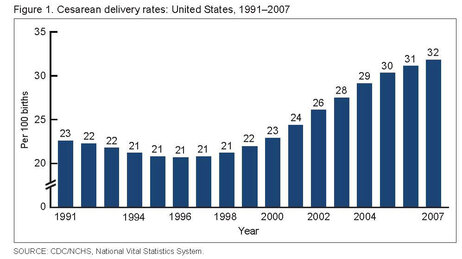
Nearly one-third of all births in the United States are by cesarean section, according to data just out from the Centers for Disease Control and Prevention.
Cesareans steadily rose in the last decade, after declining in the early 1990s. C-sections then held for a few years up to 1998, when they accounted for 21 percent of all deliveries.
Since then, though, cesareans have increased each year, rising to 1.4 million in 2007, or 32 percent of all deliveries, the highest proportion on record. Rates of cesareans in recent years have increased for women, regardless of race, age or location in the U.S. The analysis comes from the CDC's National Center for Health Statistics.
C-sections have hit an new high in the U.S. (CDC/NCHS)
Experts say part of the recent increase can be explained by more older women having children and more multiple births.
But the big increases following the year 2000 have been attributed to guidelines issued by the American College of Obstetricians and Gynecologists. The organization recommended that a surgical team be present at all vaginal births after a woman has previously given birth by cesarean. It's a standard many hospitals -- especially those in rural areas -- have trouble meeting.
Earlier this month, a panel of experts convened by the National Institutes of Health recommended those guidelines be reassessed.
Lead author of the CDC report, Fay Menacker, a statistician at the NCHS, told Shots, 'It is very important to monitor the rate of cesareans in this country, because it is a major surgical procedure that affects the health of women and infants.'
While every part of the U.S. has seen a rise in C-sections since 1996, the current rates vary a fair amount by state. Alaska, Idaho, New Mexico and Utah have rates at less than 25 percent. Florida, Louisiana, Mississippi and and New Jersey are some of the states on the high side, with rates topping 35 percent.
"
Monday, March 22, 2010
Planned Nuclear Reactors Will Destroy Atomic Waste
Incredible idea!
Read more of this story at Slashdot.
Subscribe to:
Posts (Atom)

 Posts
Posts

