Shared Branches

Friday, October 30, 2009

Did the Congressional Budget Office just kill the public option?

This looks DOA to me :(

Did the Congressional Budget Office just kill the public option?: "I've had a bad feeling since Tuesday that Connecticut Sen. Joe Lieberman's pledge to filibuster any variety of public option eliminated its chances of becoming law. Continuing recalcitrance from moderate Democrats didn't help, either. But I never figured that the final death blow would come from the Congressional Budget Office.

[more ...]

Add to Facebook
Add to Twitter
Add to digg
Add to Reddit
Add to StumbleUpon
Email this Article


Sponsored Topics:
Connecticut - Joe Lieberman - Democratic - United States - Filibuster"

Dangerous citrus pest nears California growing center

Isn't this the case every year?

Dangerous citrus pest nears California growing center: "

Pest A tiny insect that threatens California's $1.6-billion citrus industry has been found near one of the state's commercial citrus growing regions.


The Asian citrus psyllid, which has ravaged orchards in Florida as well as overseas, was found in Valley Center in rural San Diego County, the closest the bug has come to a major concentration of citrus groves. Read more here.


Photo: Los Angeles Times

"

Dark Legacy Comics

Dark Legacy Comics


Posted using ShareThis

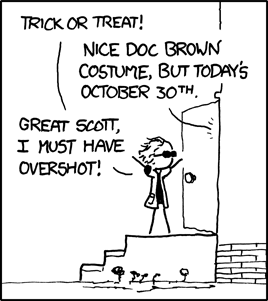
October 30th

October 30th: "Not enough houses on your block?  Just hit them at 30-year intervals from here to 2300 and get 10x the candy."

Thursday, October 29, 2009

Nearly 6 million Americans could have caught swine flu this spring, CDC says

Wow that is a lot of people!

Nearly 6 million Americans could have caught swine flu this spring, CDC says: "

Pig Between 1.8 million and 5.7 million Americans caught pandemic H1N1 influenza this spring, as many as 21,000 were hospitalized and perhaps 800 died, according to new estimates by researchers at the Centers for Disease Control and Prevention. The estimates are necessary because many cases are not reported to public health authorities and the CDC stopped requiring laboratory confirmation of new cases because the labs were becoming overwhelmed.


Epidemiologists from the CDC and the Harvard School of Public Health made the new estimates, which cover the period from the beginning of the outbreak in April through the end of July, in the online journal Emerging Infectious Diseases. There were 43,677 laboratory-confirmed cases of swine flu during the period, 5,009 hospitalizations and 302 deaths, but researchers think those are only the tip of the iceberg. Many infections were too mild for patients to seek medical care, many physicians who were visited did not order tests and many positive test results were not reported to health authorities, so the researchers had to use well-known models of disease spread to extrapolate from the cases that were reported. Similar techniques are used each year to estimate the prevalence of seasonal flu.


The team estimated that about 79 infections occurred for every one detected, giving a mean number of victims of about 3 million. They also estimate that about 2.7 hospitalizations occurred for every one reported, giving a median estimate of 14,000. They did not directly estimate the number of deaths, but other data show that about 6% of those hospitalized died, leading to a figure of 800 deaths. When figures for this fall are included, "many millions" of people have now been infected, CDC officials said.


An estimated 24.8 million doses of swine flu vaccine are now available, an increase of 1.6 million doses since yesterday, Dr. Anne Schuchat, director of the CDC's National Center for Immunization and Respiratory Diseases, said this morning in a news conference. "We aren't where we want to be, but we are seeing forward progress," she said. "Many doctor's offices are now beginning to get doses."


In other swine flu news:


- President Barack Obama's daughters, Malia and Sasha, were given the vaccine last week, it was announced Tuesday, and, since then, many blogs and websites have been critical, charging the girls with jumping to the head of the line. Interestingly some of these same sites have been critical about the safety of the vaccine and have argued that if health authorities are so confident about its safety, they should have themselves and their families immunized. Apparently, you can't please everybody.


For the record, the Obama children were not immunized until the vaccine was available for other children in the District of Columbia as well and, because of their ages, they are in one of the priority groups for vaccination. And having them vaccinated, most experts agreed, set a good example for parents everywhere.


- Antiviral drugs like Tamiflu, Relenza and now peramivir have been the mainstay of treating the very sick who have contracted swine flu, but a common, inexpensive and safe family of drugs may also be useful: cholesterol-lowering statins. In addition to their ability to lower cholesterol, the statins also reduce inflammation, which plays a role in development of the pneumonia that kills many hospitalized patients.


Dr. Ann Thomas of the Oregon Public Health Division reported at a Philadelphia meeting of the Infectious Diseases Society of America on a study of 2,800 people hospitalized with laboratory-confirmed seasonal flu in 10 states in 2007-2008; 801 of them were receiving statins, mostly people who were already on the drugs before they entered the hospital. Thomas and her colleagues found that 3% of those not taking statins died, while only about 1.5% of those receiving the drugs did. Several researchers called for testing to see if the drugs could help patients hospitalized with seasonal flu.


- Various health authorities have been emphasizing since the beginning of the current pandemic in the spring that the swine flu virus cannot be caught by eating pork. Apparently, Chinese authorities have finally gotten the message. Chinese officials said today that they will lift the ban on pork imported from America imposed last April. In 2008, the U.S. shipped nearly 400,000 metric tons of pork worth nearly $690 million to China, but so far this year, shipments have been about half the amount shipped during the same period last year. By the way, the pork industry hates the name "swine flu."


- Many of the millions who will visit Saudi Arabia next month for the annual pilgrimage or hajj will be met at the airport with face masks, hand sanitizer and fever checks, researchers reported today in the journal Science. The hajj attracts about 3 million people annually, and Saudi health officials have been working with CDC researchers to attempt to minimize the spread of swine flu in the close-packed holy cities of Mecca and Medina. Authorities will set up a network of hospitals and clinics linked to a central command center to diagnose cases and track outbreaks. Authorities are also urging all those who plan to attend to be vaccinated at least two weeks ahead of time. China has already announced that it will vaccinate its nearly 13,000 citizens who are planning to attend.


-- Thomas H. Maugh II

"

Which Religion Should I Follow?

Very funny....

Which Religion Should I Follow?: "

This flowchart explains all:


Sadly, I’m right where I should be.


Just a few hundred thousand dollars more and I’m outta here.


(via Holy Taco — Thanks to Kaleena for the link!)


Post to Twitter Post to Digg Post to Facebook Post to Reddit Post to StumbleUpon

"

The Dry Garden: John Greenlee, 'American Meadow' and the crusade against the American lawn

How great would this look in the front yard?

The Dry Garden: John Greenlee, 'American Meadow' and the crusade against the American lawn: "

AmericanMeadow


California nurseryman John Greenlee has a new book, “The American Meadow Garden: Creating a Natural Alternative to the Traditional Lawn.”


Yay?


It should be yay. In 1987, he created what is now the oldest specialty grass nursery on the West Coast. Greenlee Nursery, first in Pomona and now in Chino, is where artist Robert Irwin went when landscaping the grounds of the Getty Center. During the last 22 years, as a nurseryman, garden designer and writer, Greenlee has emerged as the single most recognizable voice of the Western anti-lawn movement.


As voices go, it’s a cheeky one. If you recall a quote in the L.A. Times in which homeowners with lawns were called “eco-terrorists,” that was Greenlee.


The signature flippancy is muted in this new book. In its stead, he asks, “Why plant a bad lawn when you can plant a good meadow?”


Given the rising recognition of the role of lawn in region-wide water shortages, the time has never been more ripe for Southern Californians to finally listen. The Los Angeles Department of Water and Power is even paying homeowners $1 per square foot to rip out lawn. The potential savings on mow-and-blow fees alone should send Southern Californians clamoring for this new book from


JohnGreenlee


Timber Press.


Yet “The American Meadow Garden” has a problem. It isn’t aimed at most homeowners. Page after page, photo after photo, Greenlee celebrates parks and park-like estates from California to Maryland. This isn’t a book for those of us with a tract house on an eighth of an acre. This is a book for people who live in “residences” in Montecito, Malibu and Napa Valley and whose massive grounds have been treated by $200-an-hour garden designers.


There is so little attention given to urban Southern California homes that you could miss the few photographs of smaller, sedge-matted green spaces whose captions identify them as city gardens. These are featured without any of the context of sidewalks, parking strips and, most tricky of all when challenging lawn culture, the neighboring properties.


Greenlee’s recommendations of invasive plants such as Mexican feather grass will drive conservationists nuts and fill homeowners with regret. Invasive plants are not just a wilderness-protection issue, unless you live to weed.


There are informational boxes with genuinely useful notes on the plants in this book, but for a text on how to choose grasses and grass-like plants, and to understand their habits and qualities, a far better source is the 1992 Encyclopedia of Ornamental Grasses. That it is also by Greenlee only underscores the slightness of the new volume.


Maybe it should not be surprising that after more than 20 years of leading a movement, Greenlee has missed an opportunity. Just as his ideas about moving away from lawn to more natural grass-scapes gain mainstream acceptance, his new book fails to lead the transition. Trailblazers — and Greenlee was surely that — often don’t implement their ideas. They inspire.


Whatever the reason, those looking to switch from lawn to meadow will be far more profitably served elsewhere. One excellent source is the website of the Lawn Reform Coalition. This alliance isn’t embarrassed by our lack of acreage, parkways, telephone poles and limited means. It’s out to help.


Note: Before using any ornamental grass, be sure to check the California Invasive Plant Council reference.


-- Emily Green


Green’s column on low-water gardening appears here weekly on our L.A. at Home blog. She also writes on water issues at www.chanceofrain.com.


Photo: John Greenlee in 2005, when he operated his nursery in Pomona.


Photo credit: Irfan Khan / Los Angeles Times


RELATED:

Experimental Pomona landscape closes.

Photo gallery: A secret garden in Pomona.

"

Attitudes about Climate Change are Shifting. Is Yours?

I am very concerned about this....

Attitudes about Climate Change are Shifting. Is Yours?: "
app_full_proxy

One possible Facebook results "badge" from KQED's "Matter of Degree" survey


Coinciding with the release of a Climate Watch Facebook survey that explores attitudes toward climate change, a new national poll by the Pew Research Center for People and the Press shows that the percentage of people who believe that climate change is a reality has decreased significantly in the past year. Last year, 71% nationwide believed the Earth was warming, regardless of the cause. This year the number is 57%.


Yesterday, Andrew Kohut, who directs the Pew Research Center for People and the Press, and Dr. Anthony Leiserowitz of the Yale Project on Climate Change joined Neal Conan on Talk of the Nation to discuss changing attitudes about climate change. (You can listen to the 30-minute segment or read the transcript here.)


Kohut said that the economy most likely plays a large role in the drop. The number of respondents who assigned a top priority to protecting the environment dropped from 56% to 41% in this year's study, while the proportion who chose dealing with the economy rose to 85%. That squares with another part of the survey, in which fewer people said they were willing to protect the environment if it meant slowing economic growth or higher energy prices.


'I think what happens,' said Kohut on yesterday's program, 'is if you're giving [the environment] a low priority, people will sometimes develop a rationale for that low priority. So you have more people saying, 'Well, maybe it's not all that serious'…'


Kohut also pointed out that the cool summer experienced by much of the country this year could have played a role in the apparent flagging acceptance of climate change.


The Pew report, released last week, shows a dramatic partisan split in attitudes toward climate change. Just thirty-two percent of conservative Republicans believe there is solid evidence for global warming, compared with 83% of liberal Democrats, according to Pew.


Leiserowitz discussed his research into attitudes about climate change, which was done in collaboration with the George Mason University Center for Climate Change Communication.


'This research really came from the recognition that Americans don't speak with a single voice about climate change,' said Leiserowitz. 'And what we found, in fact, is that there are six different Americas within America on this particular issue.' National surveys of attitudes toward climate change often yield very different results from polls in California, where there has been greater acceptance of the warming concept in general, as well as the role of human activity in it.


The original Yale-George Mason study, called 'Global Warming's Six Americas,' divides survey-takers into six psychographic groups: Alarmed (18%), Concerned (33%), Cautious (19%), Disengaged (12%), Doubtful (11%), and Dismissive (7%).


Climate Watch teamed up with Leiserowitz and his colleague Ed Maibach from GMU, to create an online version of this survey, called 'A Matter of Degree.' You can take the survey on KQED's website or on Facebook. Both versions allow you to compare your results to those of the original study as well as all online survey-takers. With the Facebook version you can also compare your results with your Facebook 'friends' who have already taken the survey and can invite new friends to take the survey. The Facebook application also features a discussion area where respondents can share thoughts about the climate change and the survey itself, and there are links to learn more about each profile 'type'.


What's your climate profile? Take the survey and find out.

"