Shared Branches

Friday, February 19, 2010

Workers at San Onofre nuclear plant fear retaliation for reporting problems, memo says

Workers at San Onofre nuclear plant fear retaliation for reporting problems, memo says: "

http://latimesblogs.latimes.com/photos/uncategorized/2008/07/30/san_onofre_scares_me.jpg

Workers at the San Onofre nuclear power plant fear retaliation if they report problems at the facility operated by Southern California Edison, according to an internal memo released by an Orange County environmental group.

The memo, written by a plant engineer, said 25 workers who reported problems at the plant said they feared retaliation from management after they made complaints. Of those workers, 17 said they did receive some type of retaliation for reporting complaints.

Details of these alleged actions were not detailed in the memo, which was released by Green San Clemente.


But the San Diego Union Tribune reported that despite those concerns, the memo noted that San Onofre workers report safety violations "10 times more often than the industry average."

San Onofre has been the subject of several investigations by the Nuclear Regulatory Commission over the last few years for various safety issues. Facility operators say the plant is safe and that they welcome employee input.

In 2008, The Times reported the twin-reactor facility ranks among the bottom 25% in overall
performance when measured against the nation's other nuclear reactors,
according to e-mailed newsletters distributed to plant employees.

--Shelby Grad

Photo credit: Los Angeles Times

"

Thursday, February 18, 2010

Alcohol and young women drivers: a deadly combination

Alcohol and young women drivers: a deadly combination: "

Drinking and driving is always a concern with young people, but a new study shows there may be fewer reasons to worry about young male drivers and more reasons to be concerned about young female drivers. Alcohol is becoming more of a factor in car crashes involving young women.


Gi80n5kf Researchers from UC San Diego, UC Irvine and Yale University looked at data on fatal road traffic collisions from the U.S. National Highway Traffic Safety Administration from 1995 to 2007 and broke young drivers down into the following age categories: 16, 17, 18, 19-20, and 21-24. During that time, 179,891 drivers age 16 to 24 were involved in fatal accidents. Overall, more men than women were involved in crashes.


However, when broken down, the numbers tell more: Rates for fatal crashes for young men fell by 2.5 crashes per 100,000 per year, decreased in men up to the age of 20, and stayed steady for ages 21 to 24. Rates for young women decreased by 0.8 per 100,000 for 16-year-olds, didn't change for 17 and 18-year-olds, and increased 0.7 for 19 and 20-year-olds and 0.6 for 21 to 24-year-olds.


The number of young women involved in fatal crashes who had a positive blood alcohol test also increased proportionately over young men--3.1% versus 1.2%. The biggest increase in all deadly crashes was seen in the number of drivers with a blood alcohol concentration of .15% of more -- almost twice the legal limit in California, which is .08%. For men that rose 2.4%, for women, 2%.


In the study, the authors note that substance abuse is growing among young women, and write, "Overall, these findings should raise the urgency of implementing effective gender-specific countermeasures to alcohol-impaired driving, including messages and education targeted to women in this age group."


The study was released today in the journal Injury Prevention.


--Jeannine Stein


Photo credit: Steve Osman / Los Angeles Times

"

Girls' Sports Build More Than Strong Bodies

Girls' Sports Build More Than Strong Bodies: "

Since I'm a skier, I love watching the Winter Olympics. All those amazing athletes performing amazing feats, on snow and ice no less! This year my 11-year-old daughter is just as engaged, in part because she has so many exceptional women to root for. Downhill racer Lindsey Vonn and the other women starring in Vancouver (how about that Jenny Potter and her three goals against Russia in women's ice hockey!) are surely an inspiration to girls everywhere.


Let's hope so anyway, because a new study from the Wharton School of Business finds that girls' participation in sports makes them more successful in all kinds of endeavors. The author discovered that Title IX, the 1972 law ending gender discrimination in funding of high school and college sports, opened a lot more doors for women than the gates to arenas.


Thanks to Title IX, girls' participation in school sports shot up from one in 27 in 1972 to one in four in 1978. It is now one in three. But their rate of sports participation is not uniform in every state, for a variety of reasons. Wharton professor Betsey Stevenson studied the variations in girls' sports participation state-by-state, and after controlling for a number of other variables was able to correlate those results with their success later in life.


Stevenson found that a 10-point rise in the percentage of girls that participate in high school sports leads to a one percentage point rise in female college attendance and a one to two point rise in labor-force participation. She also found that the advent of Title IX is connected to 20% of the increase in female attainments in higher education in the years since, and 40% of the rise in employment.


“It’s not just that the people who are going to do well in life play sports, but that sports help people do better in life,” Stevenson told the New York Times. “While I only show this for girls, it’s reasonable to believe it’s true for boys as well.”


Stevenson doesn't explain why sports participation confers such benefits, but I have a feeling the lessons learned from sports -- a competitive spirit, the value of team work, the self-confidence conferred by physical abilities -- are critical to success in most fields of endeavor later in life. Anyone have any other theories?

"

Wednesday, February 17, 2010

The trouble with Chinatown

The trouble with Chinatown: "

Ann proposes Chinatown as the greatest environmental movie of all time. Now, Chinatown is my favorite movie: the poster above is currently hanging on my office wall. it is a great movie. But Chinatown can’t be a great environmental movie for one simple reason:


It gets the environment wrong.


The conceit of Chinatown is that a diabolical mogul, Noah Cross, essentially invented a water shortage so that the city of Los Angeles could build an aqueduct. Cross then secretly bought up land in the San Fernando Valley, knowing that this land would be extremely valuable. This is at best a half-truth, and the part that is false continues to have debilitating impacts in California water policy.


It is true that a consortium of downtown businessmen, led by the likes of Moses Sherman and Harry Chandler, did buy up Valley land, knowing that the City was going to have to store the water somewhere, and the empty aquifer under the Valley’s alluvial plain was the perfect place.


But to say that Los Angeles built the aqueduct due to private greed is simply nonsense. The city built the aqueduct because it wanted to be a big city. And no: it didn’t “rape the Owens Valley” in the least. The federal government made a very open, very trasnparent decision to transfer water from the Owens Valley to Los Angeles because of a policy decision to bring water to where it could serve the most people — perhaps the only instance in US history where agricultural interests lost a water battle. Indeed, the Owens Valley acqueduct might well have been the environmental savior of the Owens Valley: without it, the Owens Valley would have turned into the equivalent of the San Joaquin Valley, whose air quality is as bad as Los Angeles’.


Chinatown, and the fake state “report” upon which it was based, have led to the pernicious myth that Los Angeles “stole its water from the Owens Valley. (The best source on the whole controversy is Abraham Hoffman, Vision or Villainy?: Origins of the Owens Valley-Los Angeles Water Controversy). This myth is permicious because it has led to the unfounded belief that somehow agricultural uses are more environmentally sensitive than urban ones (which they are not), and that somehow Los Angeles cannot be trusted. Thus, whenever California water policy is considered, agricultural interests are unified, but urban interests are not, because self-righteous Bay Area people refuse to cooperate with the evil southern Californians:


So no: Chinatown is a fantastic movie, but I think we should look elsewhere.


"

Tuesday, February 16, 2010

Scientists Intrigued By Test Of Hormone Spray For Autism

Scientists Intrigued By Test Of Hormone Spray For Autism: "

By Scott Hensley


Is there no social problem the hormone oxytocin can't ease just a little?


HHS Secretary Kathleen Sebelius.

(iStockphoto.com)


We're not convinced a test of the hormone in 13 people diagnosed with Asperger's and mild autism settles the question for a broader group of people with the disorder.


But there's quite a buzz over the small experiment in which some French researchers sprayed the hormone in the noses of autistic test subjects before they played a video game that involved some computer-generated players.


The mildly autistic people were more likely to feel cooperative after a spritz of oxytocin than when they got a placebo. They also spent more time looking at the eyes in photographs of human faces in another part of the test. The results were just published by the Proceedings of the National Academy of Sciences.

Oxytocin plays an important role in childbirth, breastfeeding and helping forge the bond between mother and child. In recent years, the hormone has been found to influence a broader range of human emotions, even increasing the level of trust that one person has for another.


Some scientists have found clues that an oxytocin deficit could be part of the autism story.


British science writer Ed Yong blogged about the paper here. Some autism researchers he talked with were intrigued by the results, but said the hypothesis needs to be put to a fuller, real-world test. 'Against my initial scepticism... I found the paper very persuasive,' Dr. Uta Frith at University College London told Yong.


Dr. George Anderson, an autism researcher at Yale, isn't so sure oxytocin could be a practical drug for autism treatment even if further experiments bear fruit. The hormone doesn't last long in the body and has trouble crossing from the blood into the brain, he told Yong.


Even so, some families have already tried oxytocin therapy, the Washington Post reports. The data to support the approach are extremely limited--especially in children, Clara Lajonchere, VP of clinical programs for Autism Speaks, told the paper. 'We have to be careful about the safety and efficacy of oxytocin on pediatric populations,' she said.


» E-Mail This » Add to Del.icio.us

"

Teenager's Science Project Leads To Simple Concussion Test

Teenager's Science Project Leads To Simple Concussion Test: "

By Richard Knox


Doctors use expensive CT scanners and MRI machines thousands of times every day to look for brain damage. But sometimes cheap and simple is definitely better.


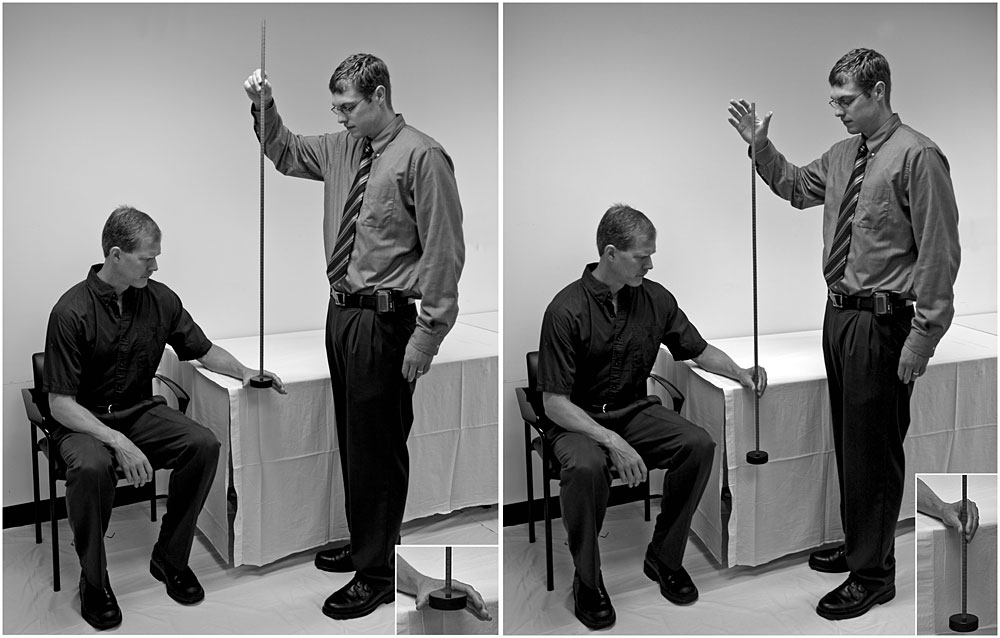
Concussion test: hockey puck on a stick.

Dr. James Eckner (standing) and Dr. James Richardson (seated) demonstrate the reaction tester devised by Richardson's teenage son. (Click on image to enlarge.) (University of Michigan)


How simple?


Take the hockey-puck-on-a-rod test a Michigan high school kid cobbled together to help figure out if a knock on the head has caused a concussion. Sports medicine specialists are increasingly worried about the long-term implications of mild, repeated head trauma.


The test is the idea of Ian Richardson. The teenager devised it as a quick and simple way to test reaction time as a science fair project.

Richardson's device looks like something out of a 19th-century medical text. It's a hockey puck, with a long rod embedded in the middle. The stick is marked off in centimeter increments.


Turns out Ian Richardson's father, James, is on the faculty of the University of Michigan Medical School. He thought Ian's idea might be a pretty cool on-the-spot way to screen for concussions among athletes.


It works like this: Tester suspends the device while injured athlete sits with forearm on table, fingers loosely circling the stick. Without warning, tester drops stick. Athlete grabs stick as fast as possible. Place where athlete grabs gives an instant readout of reaction time.


It all happens in milliseconds--too fast to measure with a stopwatch. In a pilot study of the test, athletes with concussions had reaction times that were 15 percent slower.


'Sometimes reaction time may be the only sign of a concussion -- an indication we shouldn't be sending an athlete back to play,' says Dr. James T. Eckner, who's working with Richardson to validate the test. A separate study tests whether slowed reaction times makes an injured athlete less quick to protect his face and head if they see a blow coming.


They'll present their results in April at the annual meeting of the American Academy of Neurology.


There are computer algorithms to measure reaction time, using game-like programs. But they're not so good for use at the sidelines, and they involve licensing fees.


But it remains to be seen if anyone will go to the trouble of standardizing and making the puck-on-a-stick test, if it pans out in future studies. 'Our technology transfer people say it's too simple to patent,' Eckner says.


So the Michigan researchers are working on a fancier device they call the Quick Stick. 'It has some sensors inside and a light on it,' Eckner says. 'We program it to light up on some drops and not others. The person has to make a quick choice to catch it or not depending on whether the light comes on. That makes it quite a bit more challenging.'


Of course the Quick Stick will cost more.


So Eckner and his colleagues are hoping somebody will make and sell the puck-on-a-stick device even without patent protection. If so, it might join other time-tested quick-and-simple neurological tests, like that little triangular rubber hammer the doctor uses to test your reflexes.


» E-Mail This » Add to Del.icio.us

"

San Francisco's Electric Cars Proliferate

San Francisco's Electric Cars Proliferate: "The San Francisco Bay Area is already an epicenter of the nascent battery-charged economy, thanks to a concentration of electric car charging infrastructure startups."